set.seed(20230503)

ux = 100
sdx = 2
uy = 50
sdy = 0.5

X <- rnorm(1000, mean = ux, sd = sdx)
Y <- rnorm(1000, mean = uy, sd = sdy)
Z <- X / YIn Trustworthy Online Controller Experiments I came across this quote, referring to a ratio metric \(M = \frac{X}{Y}\), which states that:
Because \(X\) and \(Y\) are jointly bivariate normal in the limit, \(M\), as the ratio of the two averages, is also normally distributed.
That’s only partially true. According to Wikipedia, the ratio of two uncorrelated noncentral normal variables \(X = N(\mu_X, \sigma_X^2)\) and \(Y = N(\mu_Y, \sigma_Y^2)\) has mean \(\mu_X / \mu_Y\) and variance approximately \(\frac{\mu_X^2}{\mu_Y^2}\left( \frac{\sigma_X^2}{\mu_X^2} + \frac{\sigma_Y^2}{\mu_Y^2} \right)\). The article implies that this is true when \(Y\) is unlikely to assume negative values, say \(\mu_Y > 3 \sigma_Y\).
As always, the best way to believe something is to see it yourself. Let’s generate some uncorrelated normal variables far from 0 and their ratio:
Their ratio looks normal enough:
hist(Z)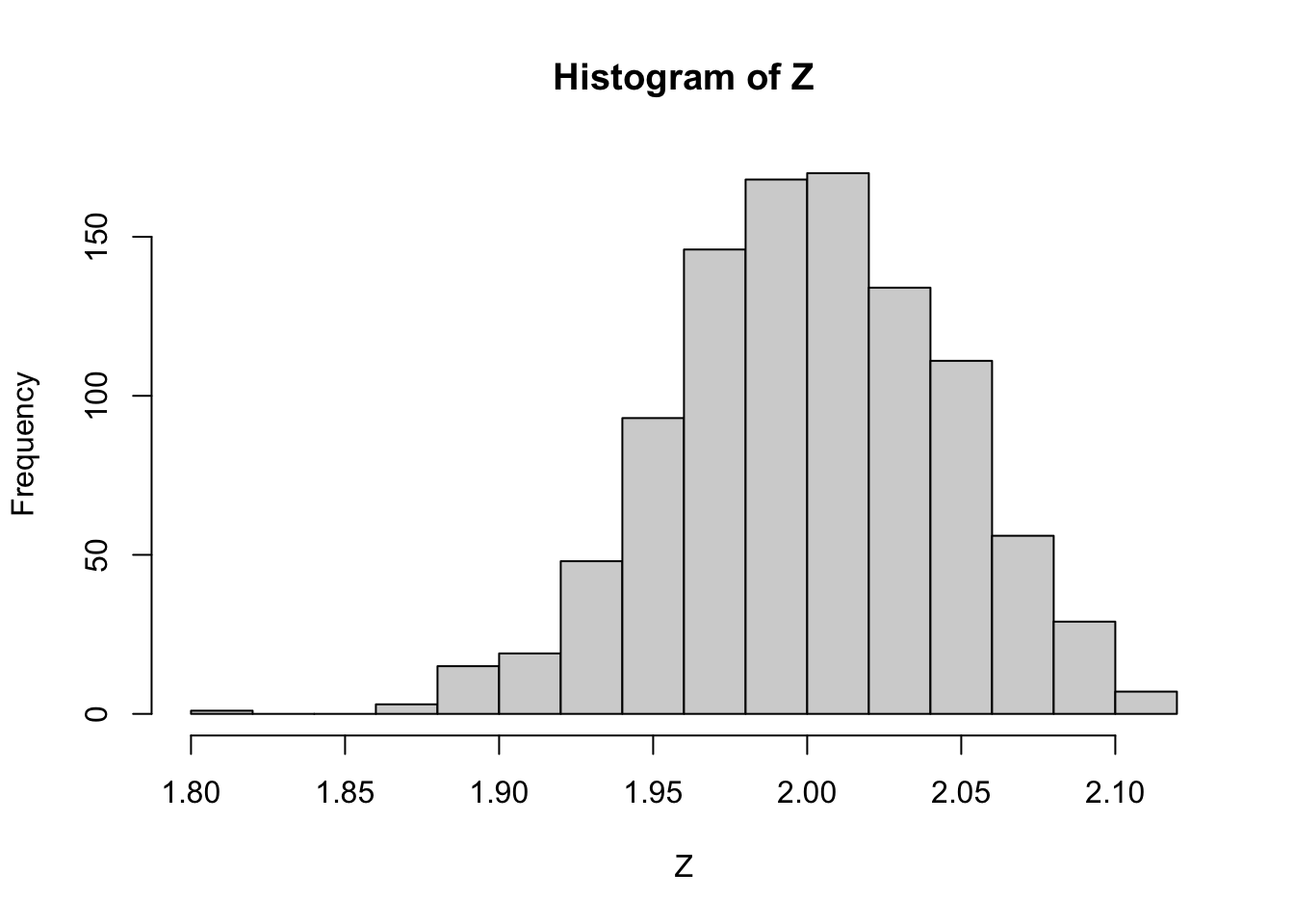
Which is confirmed by a q-q plot:
qqnorm(Z)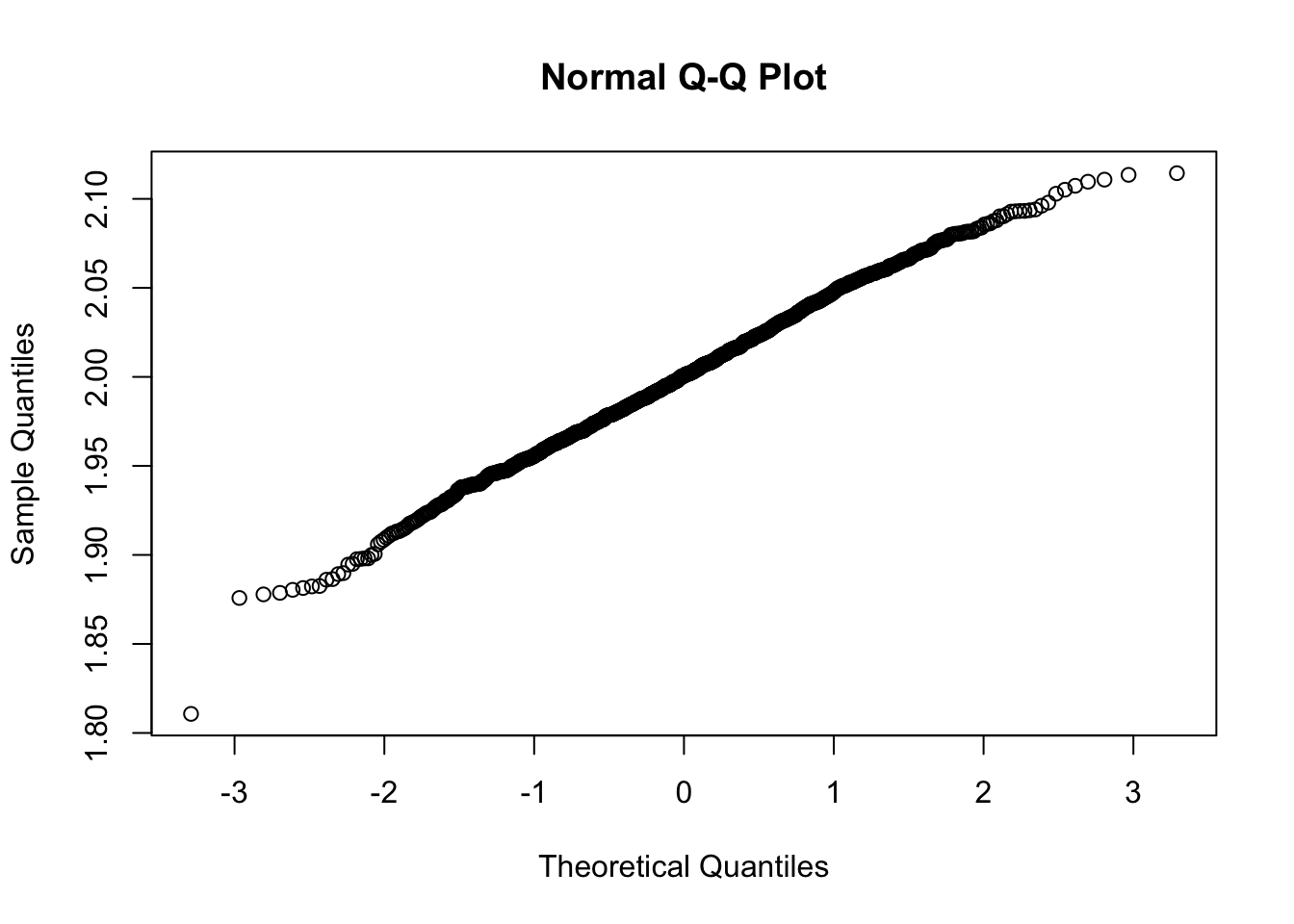
What about the mean and variance?
mean(Z)[1] 2.000533ux / uy[1] 2var(Z)[1] 0.001997246ux^2 / uy^2 * (sdx^2 / ux^2 + sdy^2 / uy^2)[1] 0.002Both the mean and variance are very close to their theoretical values.
But what happens now when the denominator \(Y\) has a mean close to 0?
ux = 100
sdx = 2
uy = 10
sdy = 2

X <- rnorm(1000, mean = ux, sd = sdx)
Y <- rnorm(1000, mean = uy, sd = sdy)
Z <- X / Y
Hard to call the resulting ratio normally distributed:
hist(Z)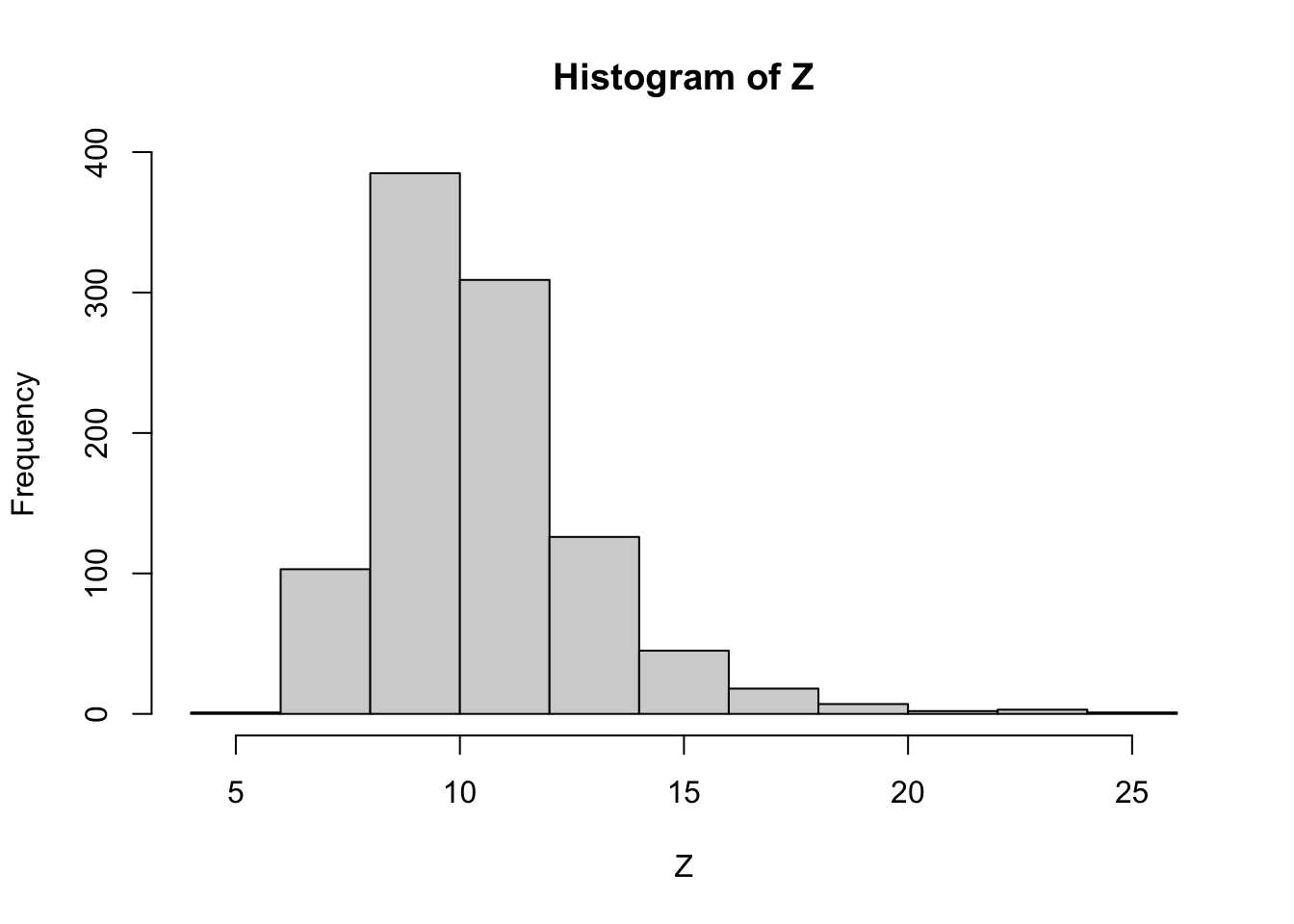
Which is also clear with a q-q plot:
qqnorm(Z)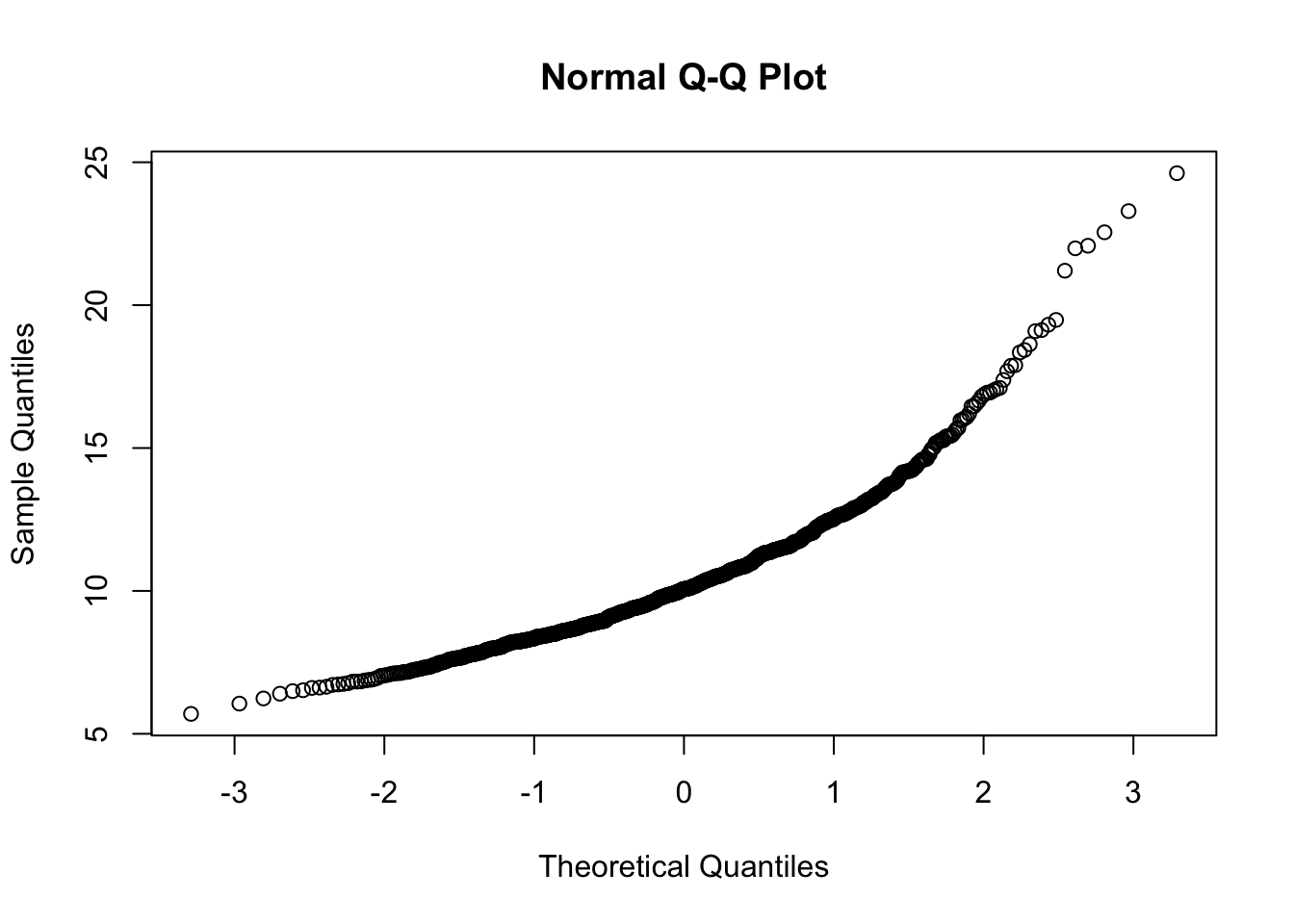
In other words, it is generally true that ratio metrics where the denominator is far from 0 will also be close enough to a normal distribution for practical purposes. But when the denominator’s mean is, say, closer than 5 sigmas from 0 that assumption breaks down.